GREEN ISLAND — When MyForest Foods, an Ecovative spinoff known for its mushroom-based bacon alternative, was founded in 2020, the business was operating out of 35,000-square-foot space at 70 Cohoes Ave.
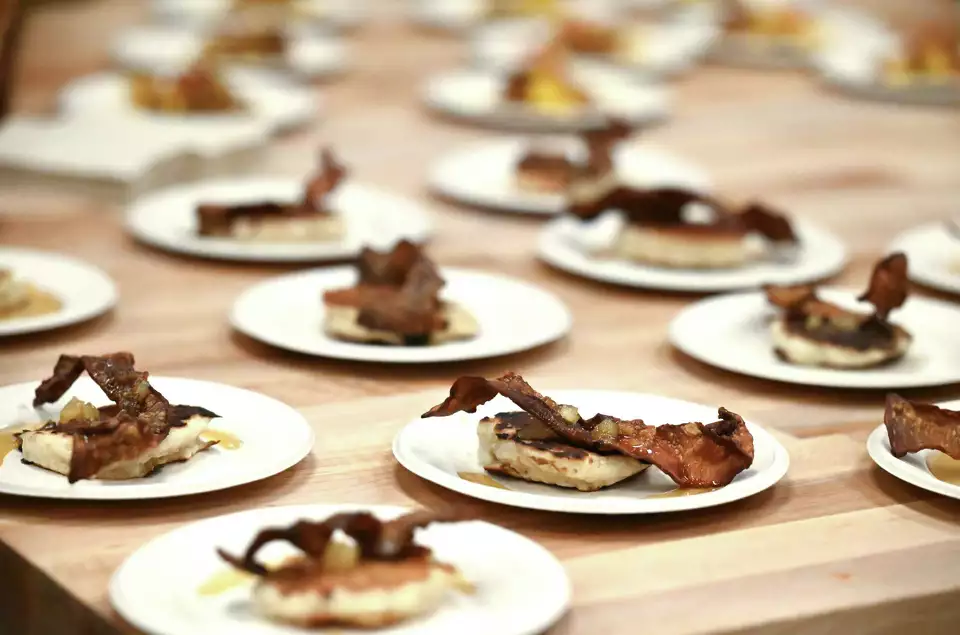
Cooked samples of MyBacon, a meatless mycelium-based bacon alternative from MyForest Foods, is displayed at the Ecovative production facility on Thursday in Green Island.

In the past two years, a massive expansion has allowed the operation to grow to 180,000 square feet — expanding its production capabilities and live mushroom farm, while also creating space to make seeds for mycelium products.
Advertisement
Article continues below this ad
Now, the facility can produce around 20,000 pounds weekly of oyster mushroom mycelium which is transformed into meatless MyBacon. (Mycelium is similar to a trunk or root for a mushroom, while the mushroom is the fruiting body that is typically eaten.)
The expansion was supported in part by a $681,000 Sustainable Technology and Green Energy grant, secured through the Advance Albany County Alliance in 2024.
At the beginning of 2025, Ecovative received an additional $1 million low-interest loan through the Alliance and the Albany County Business Development Corporation.
Don’t miss the next big story
Make the Times Union a Preferred Source on Google to see more of our journalism when you search.
Add Preferred Source
On Thursday, Ecovative, the mushroom-based technology manufacturer, received a $1.68 million check presented by the Alliance and Albany County officials.
Advertisement
Article continues below this ad
The combined grant and loan funding is intended to support the business in increasing its production capacity and expanding its workforce by generating around 160 jobs over the next five years in Green Island. The new jobs will vary from part-time manufacturing positions to lead research and development roles.
MyForest Foods co-founders Eben Bayer, also co-founder and CEO of Ecovative, and Steve Lomnes, also CFO and chief strategy officer for Ecovative, explained that the demand for their products exceeds their current capacity.
“All these rooms are full and growing every week right now,” Bayer said while giving a tour of the facility. “We’re maxed out on growing here.”
The inside of the vertical mushroom farm is a sterile, lab-like environment, with workers donning white lab coats, hair nets, safety goggles, and shoe booties as they work alongside an 18-foot tall rack with 12 rows of unharvested mycelium beds.
Advertisement
Article continues below this ad
The mycelium looks unrecognizable compared to a farmer’s market oyster mushroom. Rather than having a typical mushroom cap, the mycelium’s growth is reprogrammed using environmental conditions to ensure it’s grown in an “industrialized format” that allows for it to be more predictable.
Mycelium sprouts up as a soft and stretchy uniform layer from a bed of wood pellets. Bayer described the work the team does as “magic,” as mycelium sprouts from wood pellets to create “clean, quality food.” The wood fiber is then repurposed into soil and compost.
The fuzzy growth is squished by a robot and condensed to the density of a pork belly. After a second squish, it’s sent to a pork belly slicer to create slices of MyBacon. While the air handlers, racks and conveyor belts are standard equipment, the mycelium is collected using a custom harvesting mechanism, which makes the process safer and less labor-intensive.
“Most mushrooms are picked off the bed by hand,” Bayer said. “No one’s ever grown mycelium like this.”
Advertisement
Article continues below this ad
Bayer explained that in a forest the misty atmosphere encourages the mycelium to emerge to the surface. As it gets drier, the mushroom begins to form.
In the MyForest grow operation, mist is a constant variable used to control growth.
“It’s like 7 a.m. all the time at the farm for the mushroom,” Bayer said, referring to the mist. “They just keep growing up. They think they’re always exiting the soil.”
Conditions are critical for the fungus. Bayer explained the speed in which air is blown determines the mycelium’s striations — the faster blown, the more chaotic the striations are which can result in a gristle-like texture. Kris Murphy, who’s been with the company since June, controls the conditions in the grow rooms.
Advertisement
Article continues below this ad
Murphy explained that the temperature and moisture levels are key to the growing conditions. Murphy said, “We keep a tight watch on that.”
Before coming to MyForest Foods, Murphy worked in Silicon Valley as a project manager. Now, she spends her days working with her hands. Some days, she can be found wearing a hard hat and drilling holes.
“There’s always some new innovation happening,” Murphy said. “It’s so much better than just sitting at a desk every day, that’s what I used to do.”
While Bayer said developing innovations has been integral to the company, now the focus is on implementing their innovations at scale — “scaling our growth processes, scaling our bacon process and bringing ideas to life with these products to people around the globe,” he said.
Advertisement
Article continues below this ad
Lomnes said that last week, the manufacturer shipped “the equivalent of about $3.5 million annualized bacon product.”
But currently, only about a third of the mycelium used to make MyBacon comes from Green Island. The remaining two-thirds of the mycelium comes from partner farms making air-mycelium type products— with two in the Netherlands, one in Ontario and a farm in Pennsylvania currently being tested.
“We do not have enough capacity to grow enough mycelium for the next stage of our growth,” Lomnes said. “We need more farm partners.”
Global trade is a big part of their overall business, Lomnes said, and they are navigating through the increase in tariffs. Lomnes said he hopes that they can create more partnerships with New York farms to produce more mycelium products in New York and Albany County.
Advertisement
Article continues below this ad
The demand for the mushroom-based bacon comes from its five-ingredient recipe, Sarah-Marie Cole, chief marketing officer of MyForest Foods, explained. Meat alternatives have long been criticized for being ultra-processed, as well as having textures and tastes that are incomparable to the food products they claim to replace.
Rather than rely on pea or soy proteins to act as binders, the oyster mushroom base gives its MyBacon a natural umami flavor, Cole said. With organic mycelium, salt, sugar, coconut oil, which helps it sizzle like bacon, and natural smoke flavors, which give it a bacon-like scent, MyForest foods has created the fastest-selling plant-based breakfast item in the natural channel, Bayer said, with a retail footprint spanning 1,200 grocery retailers nationwide.
“We don’t have to do much,” Cole said. “It already has a base flavor. It just soaks in and makes it pretty easy.”
As of now, MyBacon is MyForest Foods’ only food product in retail. But this summer, the company is expanding to offering a mushroom-based pulled pork alternative created by using the scraps from the MyBacon for the “maximum utilization of mycelium,” Cole said. Every Friday at noon, MyForest Foods offers free lunch to team members willing to give feedback on its products.
Advertisement
Article continues below this ad
While Lomnes is proud of the great-tasting product he’s helped develop, the environmental impact creates a deeper sense of pride.
“Every time that somebody buys one of these packs of bacon instead of pork bacon, it’s offsetting — from a carbon perspective, a water perspective, a land-use perspective — 10, 20, 25 packs of pork bacon, which is really outstanding,” Lomnes said. “So if we have 1% market share, we have a very outsized impact from a sustainability perspective.”