We grow gourmet oyster mushroom mycelium on wood chips and other locally sourced plant material. We plant this mycelium in existing American mushroom farms throughout Pennsylvania.
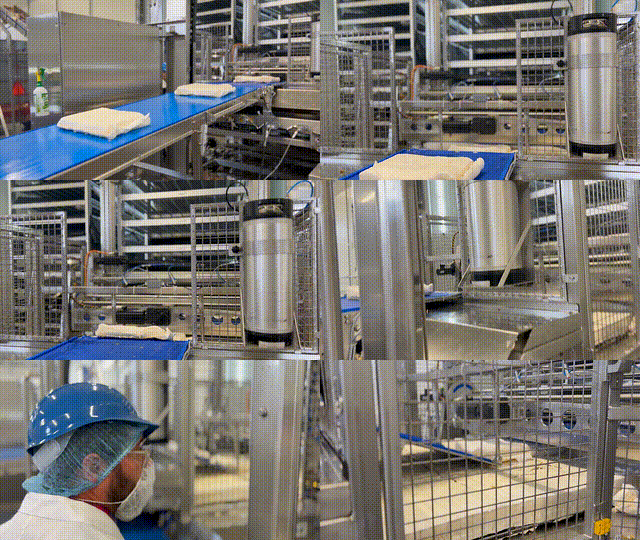
As our mycelium grows, it forms a thick sheet that we harvest after just three weeks. Its interwoven fibers give our foods their texture and body. We slice the sheets into strips. MyForest Foods brines them to make MyBacon, ready for a hot pan.
It's been 400 years since mushrooms were first domesticated. We've managed to further domesticate the gourmet oyster mushroom for conventional large-scale mushroom farms, bringing its delicious texture and flavor to more people in more formats. Our new crops give American farmers new opportunities to strengthen and grow their farms.
Bringing a new crop into agriculture takes years of work around the organism. Farmers need dependable inoculum, a growing process they can repeat, and equipment that can handle the harvest. Customers need consistent material delivered when promised.
We develop those pieces together. A change in the strain can affect the growing cycle, the harvesting equipment, and the finished product. Each production run teaches us how to make the next one more reliable.
AirMycelium™ adapts the rooms and equipment already used on mushroom farms to grow this crop. We develop the process, then work with farmers to establish it at their farms.
Our first materials, mycelium composites, used mycelium to bind agricultural byproducts together. The fungus grew through the particles, joining them into a solid shape.
With AirMycelium, we learned to grow sheets of fungal tissue above the growing bed and harvest them separately. The fibers themselves became the material. That opened a different set of possibilities, including the texture of food and the structure of textiles.
Each application asks something different of the organism. The strain, growing conditions, equipment, and finished product have to work together.
Grow what we used to make.
A material’s properties depend on its chemistry and its structure. Living organisms build both as they grow. The arrangement of fibers gives wood its strength and helps give food its texture.
At Ecovative, we are learning to direct that assembly in mycelium. By choosing the organism and controlling its growing conditions, we influence the structure it builds. Our long term ambition is to grow increasingly complex materials with the precision that living systems already demonstrate.
The path to universal molecular manufacturing
Domesticate mycelium as a crop
Make useful food and materials
Bring the crop to more farms
Learn to grow more complex structures
Grow more of the things people use every day
Make those things widely available and affordable
Our ambition is to grow increasingly complex materials with the precision that living systems already demonstrate.
Learn how to grow it. Then learn how to make it reliably.
Each application asks something different of the organism. Food needs a texture people enjoy eating. A textile needs consistent strength and a surface that can be finished. Packaging has to protect a particular object at a price the customer can afford.
Developing the material and the process
Our foundry starts with those requirements. We test where the biology fits, what the process needs, and whether the economics can support a business. The experience from one material informs the next experiment.
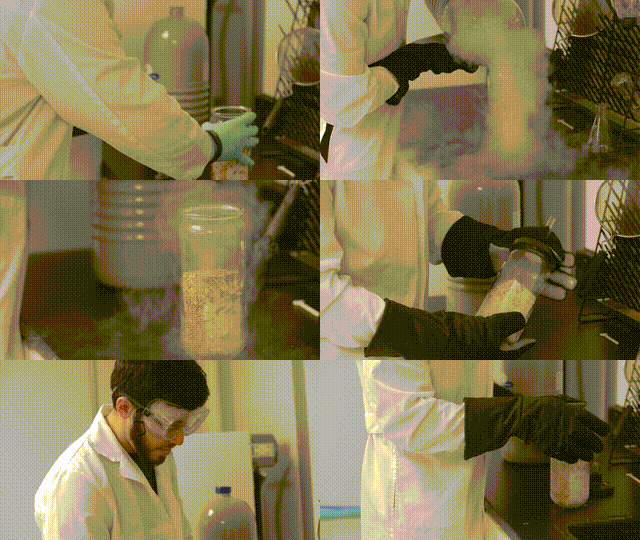
We work across fungal strains, growing recipes, and the equipment that controls the environment. Temperature, humidity, airflow, and CO₂ influence how the tissue develops. We measure the resulting material and use those observations to refine the next growing cycle.
From our facility to a partner farm
We transferred our growing process from New York to Pietro Mushroom Farm.
That work extends beyond a recipe: it includes the equipment, operating procedures, and quality checks a farm needs to repeat the harvest.
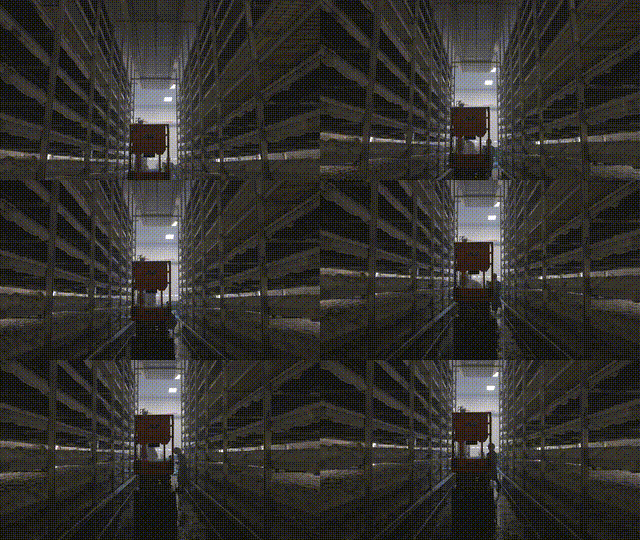
Partner farms let us expand production using existing mushroom growing rooms.
What we measure
Strains: We test fungal strains and growing recipes against the requirements of the product.
Growing conditions: Temperature, humidity, airflow, and CO₂ influence how the tissue develops.
Material properties: We measure the resulting material and use those observations to refine the next growing cycle.
Federal research partners
Now
Contract fermentation and biological manufacturing
Develop your process here, from pilot batches to production.
Our team runs pilot batches in configurable chambers, measures the results, and develops a plan for production in our larger growing rooms.
01 / Inoculum02 / Growing room03 / Harvest
4Configurable pilot chambers
10 × 4 × 8 ftInterior dimensions of each chamber
6Production growing rooms
~74,000 ft²Installed growing bed area
Each production room holds up to 24 long growing shelves. Usable capacity depends on the process and production setup.
Assess the processWe review your organism, substrate, growing conditions, cycle time, harvest method, and target output.
Run pilot batchesWe control airflow, humidity, temperature, and CO₂, then sample the crop and document the results.
Plan productionWe use the pilot results to plan production beds, operating procedures, quality checks, and a repeat production schedule.
Technical support
Process, organism, and substrate assessment
Strain screening, growing recipes, and inoculum planning
Temperature, humidity, CO₂, and airflow control
Substrate preparation, automated filling, harvest, and drying plans
Sampling, quality checks, production planning, and process transfer
Processes we can assess
The system supports solid state fermentation on trays, shelves, and growing beds.
Food fermentationMyceliated ingredientsKoji and starter culturesSpawn and inoculumMicrobial agricultureMycelium materialsSpecialty crop trials
Tell us what you want to grow
Tell us what the organism needs and what the finished product must do. Send your substrate, current scale, target output, regulatory category, and timeline. We will assess whether our facilities suit your process.
We review each program’s organism, containment needs, certification requirements, and regulatory status before accepting the work.
In development
Forager: mycelium for textiles
We grow the structure of the material.
Forager starts as a sheet of mycelium grown on a farm. We are developing it with fashion and electronics brands for the stretch, drape, and toughness required in finished products.
Development: We work with fashion and electronics brands.
Growth: The growing process establishes the fibrous structure.
Finishing: Harvesting and finishing develop that structure for its intended use.
Performance: We develop Forager for the stretch, drape, and toughness required in finished products.
From the growing bed to the finished surface
Stage
Strain
Growth
Finish
Work
Select
Cultivate
Process
Focus
Organism
Structure
Surface
Check
Repeatability
Consistency
Use
How we tune the material
The growing process establishes the fibrous structure. Harvesting and finishing develop that structure into a material suited to its intended use. The strain, the growth conditions, and the finish all affect the result.
A material has to perform consistently across a sheet and from one harvest to the next. Our development work follows it through those steps, from the growing bed to the finished surface.
We are studying how growing conditions affect the compounds mycelium produces, and how to make those compounds consistently at farm scale.
Computing with mycelium
Our researchers grow mycelium structures, infuse them with a conductive polymer, and test how they process electrical signals.
Here, the structure we grow becomes part of an electrical device.
The research asks how the arrangement of mycelium fibers affects the way signals move through the material, and how that behavior can be used for computation.
We began by asking whether a fungus could grow the glue that holds a material together. Insulation and packaging gave us a way to test that idea in products. They also taught us to work with the organism through production, handling, and use.
Launched 2010
Mushroom® Packaging
Protective packaging grown from plant material and mycelium. Customers have included Dell, Steelcase, and Renais Gin.
We want more people to have access to good food and the materials they need to live well. That requires products people want, processes farmers and manufacturers can operate, and costs that support widespread use.
Biology represents our most advanced technology.
We are domesticating mycelium as a living technology.
Technological abundance fuels democracy and capitalism.
Biology offers a way to build those products from renewable inputs. Our ambition is to make that way of manufacturing increasingly capable and widely available, while caring for the living systems that support us on Spaceship Earth.
How we work
Results: Judge the work by what it accomplishes.
Growth: Build a business that earns more customers.
Agency: Take responsibility for making things happen.
Integrity: Tell the truth and keep your commitments.
Discipline: Finish the work and check the result.
The team
Help us grow useful things.
Our work brings mycologists and engineers together with the people who run production and build the business. A useful idea has to survive the growing room, the harvest, and the customer’s application. We need people who can work across those boundaries and carry an experiment into daily operation.
How we work
Set clear business goals and give people room to decide how to reach them.
Demonstrate ideas through experiments and working products.
Choose practical solutions that solve the problem.
Keep projects focused and use resources carefully.
Trust people to take responsibility and act.
The work brings together
Mycology and strain development
Engineering and process development
Farming and daily production
Product development and customer applications
How we got here
Growing up on a Vermont farm, Eben notices mycelium binding wood and plant matter together.
2007: Eben Bayer and Gavin McIntyre found Ecovative at Rensselaer Polytechnic Institute.
2010: Mushroom® Packaging launches commercially.
2016: Ecovative develops AirMycelium™.
2020: MyForest Foods introduces MyBacon.
2024: AirMycelium production expands to partner farms.
2026: We are expanding production and developing new uses for mycelium.